
As I said in my blog about HSV-1, it has been a crazy couple of weeks! Why, you ask? Because of the coronavirus (Covid-19)! The virus I talked about before but there still wasn’t much information out about it. Since then, this virus has spread like crazyyy around the world and there is lots of new information now circulating. First and foremost, it is important to know how exactly the virus is spread since there are ways to prevent it. According to the CDC, Covid-19 can be spread from person-to-person through close contact (within 6 feet) or through respiratory droplets when an infected person coughs or sneezes. People are most contagious when they are symptomatic, but some spread may be possible before people show symptoms (although this is not the main way of spread). The virus is also spread from contact with contaminated surfaces or objects by people touching the surface and then touching their own mouth, nose, or eyes. Covid-19 spreads easily through “community spread” in some affected areas. This means “people have been infected with the virus in an area, including some who are not sure how or where they became infected.”
The Pandemic
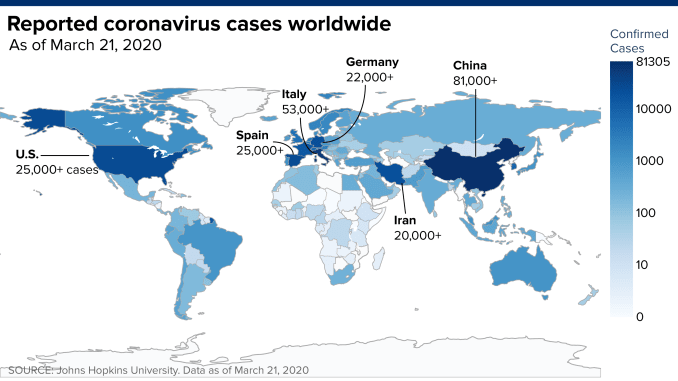
As previously noted in my past blog, the outbreak of the coronavirus originated in Wuhan, China, but has since spread to many areas around the world. According to Vox, an online magazine, “it has spread far wider than Ebola did in 2014, and the World Health Organization has designated it a pandemic,” so crazy and scary! As stated in CNBC, although there are frequent updates by the news medias and independent researchers on the outbreak, the available data “represents only a portion of the total number of cases, many of which have gone unreported.” As of March 21, 2020, China had reported more than 80,000 confirmed cases, while the United States had confirmed more than 25,000 cases. Worldwide, there has been over 14,000 deaths! The only problems with these numbers is that the cumulative cases don’t account for the patients that have recovered or the lags in reporting cases. Just by facing the numbers, however, it doesn’t show the response of how fast the virus is spreading. In the US alone, all 50 states have reported cases of the virus to the CDC, while three of the states are experiencing sustained community spread.
The Dreaded Quarantine
As the virus is rapidly spreading, it is important for people to take the necessary precautions to prevent further spread. The most important way to prevent this spread is by being in quarantine for at least 2 weeks since the virus is known to have an incubation period of about 14 days. Covid-19 has made large-scale gatherings/meetings unpopular as people are trying to keep their (6-foot) distance until everything is under control. The rapid spread of this virus has led to school shutting down around the world, jobs shutting down, and even state borders being shut down. The only way to have some control over the virus is by trying to contain the spread of it while researchers are learning more about it. According to Vox, a single day’s delay in social distancing can increase the outbreak of Covid-19 significantly, by 40%!! While we are all dreading staying inside for 2 weeks until we know we are not sick, it is important to remind yourself the reasoning behind it. It is also very important to remember that even though you don’t feel sick, doesn’t mean you’re safe to move around. As I have been stuck in my house this past week, it has come to my interest that I remain inside as I don’t want to risk getting sick and giving the virus to the rest of my family. Just remember, the sooner this is contained, the quicker we are out of quarantine!

 V's Microbionic